

Pinnacle Child Development Clinic, 202, 2nd Floor, Kanaiya Building, Opp. Airtel Store, Linking Road, Bandra West, Mumbai - 400050


The Brain Is Not Fixed — It Is Constantly Learning
In India, nearly one in six children is estimated to have some form of developmental delay or neurodevelopmental risk. Despite this, many families still assume that brain development is fixed early in life. In reality, the developing brain is highly adaptable. Its ability to change, reorganize, and form new connections—known as neuroplasticity—plays a crucial role in childhood development.
Neuroplasticity is the scientific foundation behind the success of early intervention. It explains why timely support can help children develop speech, social interaction, emotional regulation, and independence. When intervention begins early, the brain is most responsive to learning and change, allowing skills to be built more efficiently and sustainably over time.
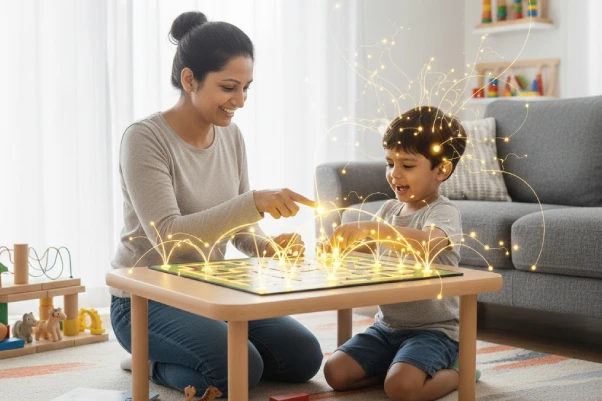
Neuroplasticity refers to the brain’s ability to form new neural connections and strengthen existing ones in response to experiences, learning, and repeated practice. Every time a child tries a new sound, movement, or social interaction, the brain responds by adjusting its wiring.
In early childhood, the brain is especially flexible—constantly shaping itself based on what the child sees, hears, touches, and practices.
The most powerful window for neuroplasticity is from birth to 3 years of age. During this time:
This is known as the critical period. Intervening during this phase can significantly alter a child’s developmental trajectory.
Early intervention works because it provides targeted, repeated stimulation to the developing brain. Therapy does not just teach skills—it changes brain wiring.
Examples include:
With repetition and consistency, new neural pathways become stable and long-lasting.
Early intervention for autism focuses on leveraging high brain plasticity before age 3. During this stage, children are more receptive to learning communication, social engagement, and adaptive behaviors.
Research shows that early therapy can:
The goal is not to “change the child,” but to support the brain in developing alternative, effective pathways.
When intervention is timely and consistent, neuroplasticity supports:
Early support also helps minimize delays, reduce the impact of developmental disorders, and improve a child’s ability to reach milestones.
To use neuroplasticity effectively, intervention must be individualized. A comprehensive assessment looks beyond diagnosis to understand:
This holistic approach allows therapists and parents to create meaningful, brain-based intervention plans.
Parents do not need to “wait and watch” when concerns arise. If something feels off, action should begin early.
Important points to remember:
Early action maximizes neuroplastic potential.
Q. What is neuroplasticity?
Anwer: It is the brain’s ability to change and rewire through learning and experience.
Q. Why is early intervention so important?
Anwer: Because the brain is most adaptable before age 3.
Q. Can therapy really change brain development?
Anwer: Yes. Repeated skill practice strengthens neural pathways.
Q. Is neuroplasticity useful after early childhood?
Anwer: Yes, but learning is fastest and easiest in early years.
Q. Should parents wait for a diagnosis before starting therapy?
Anwer: No. Early support can begin based on concerns alone.
“Mealtimes are peaceful now, and my child is trying new foods.”
“We saw progress once we started intervention early instead of waiting.”
“Learning about neuroplasticity gave us hope and clarity.”
As a Developmental and Behavioral Pediatrician, Dr. Rajeshwari Ganesh works at the intersection of neuroscience, child behavior, and family-centered care. Her clinical approach is strongly rooted in understanding how the developing brain adapts, learns, and reorganizes—the very foundation of neuroplasticity.
She completed her advanced Fellowship in Developmental & Behavioral Pediatrics at the National University Hospital, Singapore, gaining extensive exposure to early identification and intervention models followed internationally. She holds MRCPCH, MD Pediatrics, DCH, and MBBS qualifications, with over a decade of hands-on clinical experience in Mumbai.
In everyday practice, Dr. Rajeshwari Ganesh conducts in-depth developmental evaluations that go beyond labels, focusing on how each child processes information, interacts socially, communicates, and regulates behavior. She routinely uses internationally validated assessment tools such as the Capute Scales, Amiel-Tison Scales, PEP, Early Start Denver Model Curriculum, CARS, and advanced neurodevelopmental batteries including PEER, PEERAMID, and PEEX2.
She is among the few professionals in India certified to administer ADOS (Autism Diagnostic Observation Schedule) and the Bayley Scales of Infant and Toddler Development, widely regarded as gold standards for assessing early neurodevelopment.
A significant part of her work involves early intervention planning, parent training, and empowering families to actively participate in therapy—recognizing that repeated, meaningful experiences at home are critical for strengthening neural pathways. She also leads a high-risk neonate surveillance program at Surya Hospital, a tertiary NICU in Mumbai, focusing on early detection and brain-based developmental support.
Beyond the clinic, Dr. Rajeshwari Ganesh regularly conducts workshops for parents, teachers, and allied health professionals, translating complex brain science into practical strategies that families can use every day.
Neuroplasticity reminds us that a child’s future is not predetermined. The brain is constantly learning, adapting, and reshaping itself—especially in the early years. When parents act early and interventions are thoughtfully planned, neuroplasticity becomes a powerful ally, helping children reach their fullest potential and improving long-term outcomes.
Pinnacle Child Development Clinic, 202, 2nd Floor, Kanaiya Building, Opp. Airtel Store, Linking Road, Bandra West, Mumbai – 400050
📞 +91 77000 58024
📧 ganesh.ramaa@gmail.com
🌐 https://www.drrajeshwariganesh.com
🕒 Open: 24×7 × 365 Days
Copyright © 2023 | Dr. Rajeshwari Ganesh.