

Pinnacle Child Development Clinic, 202, 2nd Floor, Kanaiya Building, Opp. Airtel Store, Linking Road, Bandra West, Mumbai - 400050


For many families, daily routines quietly revolve around a single concern—what the child will eat. In India, surveys indicate that approximately 30–45% of children between two and six years of age exhibit picky eating behaviours at some stage. What may begin as mild food selectivity can gradually lead to anxiety, frustration, and mealtimes marked by negotiation, pressure, or silence.
Picky eating is one of the most common feeding challenges in early childhood and, in most cases, does not indicate illness or poor parenting. However, the way adults respond—both emotionally and behaviourally—can significantly influence whether this phase resolves naturally or becomes a long-term struggle. When approached with understanding, consistency, and appropriate guidance, children are more likely to develop a healthier relationship with food and mealtimes over time.
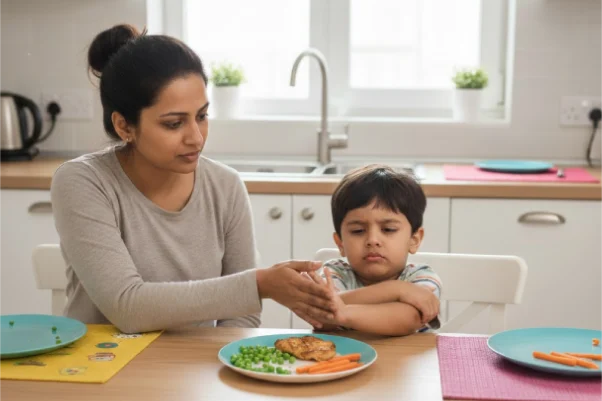
A picky eater is not simply a child who dislikes one or two foods. These children often:
This behavior is not driven by hunger alone. It is closely linked to temperament, sensory sensitivity, rigidity in thinking, and emotional regulation.
Between 2 and 4 years of age, children across cultures enter a phase of food neophobia—fear of new foods. This is believed to be a protective instinct. As toddlers gain independence and mobility, the brain becomes cautious about unfamiliar items entering the mouth.
This explains why many children:
In most children, this phase improves naturally—if pressure does not escalate.
One of the most damaging myths is that picky eating is caused by poor parenting. In reality, many picky eaters have siblings who eat everything without difficulty.
Some children are simply born with more rigid or sensitive nervous systems. When parents understand this, they replace guilt with strategy—and that shift alone improves outcomes.
A child does not need to show all signs to begin—what matters is willingness and comfort.
Parents often act from fear—fear of hunger, poor growth, or future health. Unfortunately, some common responses reinforce picky eating:
These patterns reduce hunger at meals and increase food refusal.
Research consistently shows that exposure—not pressure—is the key. Children may need 8–15 neutral exposures to a new food before accepting it.
Effective strategies include:
Feeling hunger is safe. Hunger helps the brain become open to food.
Children eat better when meals feel predictable and emotionally safe. Helpful routines include:
Children consume most of their calories in the first 20 minutes. Long, pressured meals often increase resistance.
While most picky eating is mild, some children require help. Seek evaluation if your child:
Severe picky eating may overlap with anxiety disorders, sensory processing differences, or neurodevelopmental conditions and benefits from structured intervention.
Evidence-based approaches—often rooted in exposure-based cognitive behavioral principles—focus on parent coaching rather than forcing the child. Parents are trained to guide daily food exposure calmly and consistently.
Children may not feel unhappy about their eating, but early intervention protects long-term physical health, social participation, and emotional well-being.
Q. Is picky eating just a phase?
Anwer: Often yes—but how it is handled determines how long it lasts.
Q. Should I force my child to eat?
Anwer: No. Force increases anxiety and resistance.
Q. How many times should I offer a new food?
Anwer: At least 8–15 times, without pressure.
Q. Is it okay for my child to feel hungry?
Anwer: Yes. Hunger supports healthy appetite regulation.
Q. When should I seek professional help?
Anwer: If picky eating is severe, persistent, or affecting growth or family life.
“Mealtimes are peaceful now, and my child is trying new foods.”
“We finally stopped forcing food and saw real change.”
“Simple guidance made a big difference for our family.”
With over a decade of experience, Dr. Rajeshwari Ganesh is a trusted Developmental and Behavioral Pediatrician in Mumbai, known for her calm, structured, and parent-empowering approach.
She has completed advanced fellowship training in Developmental & Behavioral Pediatrics from the National University Hospital, Singapore, and holds internationally recognized qualifications including MRCPCH, MD Pediatrics, DCH, and MBBS from Mumbai University.
Her work involves detailed developmental and behavioral assessments using globally accepted tools such as Capute Scales, Amiel Tison Scales, PEP, Early Start Denver Model Curriculum, CARS, and advanced neurodevelopmental assessments including PEER, PEERAMID, and PEEX2.
Dr. Rajeshwari Ganesh is among the few professionals in India certified to administer ADOS (Autism Diagnostic Observation Schedule) and the Bayley Scales of Infant and Toddler Development, both considered gold standards worldwide.
She also leads a high-risk neonate surveillance program at Surya Hospital, a tertiary NICU in Mumbai, and regularly conducts workshops for parents, teachers, and healthcare professionals on child development.
Picky eating is not a failure—it is a developmental challenge that responds best to patience, structure, and understanding. When parents shift from pressure to guidance, children gradually expand their food choices and rebuild a healthy relationship with eating. Early, calm support prevents long-term struggles and restores joy to family meals.
Pinnacle Child Development Clinic, 202, 2nd Floor, Kanaiya Building, Opp. Airtel Store, Linking Road, Bandra West, Mumbai – 400050
📞 +91 77000 58024
📧 ganesh.ramaa@gmail.com
🌐 https://www.drrajeshwariganesh.com
🕒 Open: 24×7 × 365 Days
Copyright © 2023 | Dr. Rajeshwari Ganesh.