

Pinnacle Child Development Clinic, 202, 2nd Floor, Kanaiya Building, Opp. Airtel Store, Linking Road, Bandra West, Mumbai - 400050


Sleep challenges are one of the most common yet least talked-about reasons families seek developmental guidance. Even in otherwise healthy children, difficulties such as trouble settling at bedtime, repeated night awakenings, or dependence on a caregiver to fall asleep can gradually take over daily routines. Across India, a significant proportion of children below five years of age experience ongoing sleep disruptions, which over time affect not only the child’s emotional regulation and behaviour, but also parental wellbeing and overall family balance.
Healthy sleep patterns are learned gradually through consistency and emotional safety rather than instinct alone. Supportive sleep guidance does not involve forcing independence or ignoring distress; instead, it focuses on creating calm, predictable routines that help a child’s brain recognise when it is safe to relax and rest. With the right structure and reassurance, children develop confidence, self-regulation, and sustainable sleep habits that benefit the entire family.
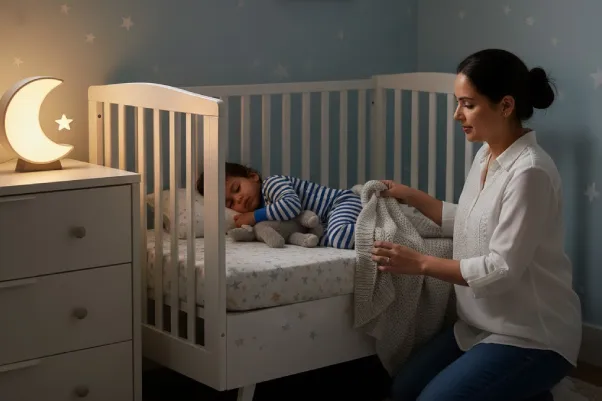
Many young children struggle to settle at bedtime or wake repeatedly during the night. For some families this may be manageable, but for others it leads to chronic sleep deprivation.
Common reasons include:
Each child’s sleep pattern is unique, and difficulty sleeping does not reflect poor parenting or a “difficult” child.
Sleep training refers to helping a child learn to fall asleep independently and return to sleep during normal night awakenings. It does not follow one rigid method and should never feel distressing or unsafe.
The foundation of sleep training is consistency, predictability, and emotional security. Children feel safest when they know what comes next, and sleep routines provide that reassurance.
There is no perfect age to begin sleep training. The decision depends on:
Parents should only use approaches they feel comfortable with. Gentle, gradual strategies are often more sustainable than abrupt changes.
If a child refuses to go to bed, the first step is setting a realistic bedtime. Begin a calming “wind-down” routine around 30 minutes before sleep.
Helpful strategies include:
If the child gets out of bed, gently return them with minimal conversation. Consistency is key.
A predictable routine supports sleep regulation. Useful tips include:
When a child wakes at night, remain calm and uninteresting—keep lights low and interactions minimal.
Night waking is normal in children, but how parents respond determines whether the pattern continues. Reintroducing feeding, rocking, or play during the night can unintentionally reinforce waking.
Respond with reassurance, not stimulation. The goal is to help the child return to sleep using the same conditions present at bedtime.
Children with long-term illnesses, developmental delays, or disabilities often experience more sleep disruption. Sensory sensitivities, anxiety, or neurological differences can interfere with sleep regulation.
These children benefit from individualized sleep plans, parent counselling, and sometimes multidisciplinary support. Sleep training should always be adapted—not forced.
Seek professional advice if:
A structured developmental and behavioral assessment helps identify underlying contributors and guides appropriate intervention.
Q.Is sleep training safe for children?
Anwer: Yes, when done gently and developmentally appropriately.
Q. Will sleep training harm my child emotionally?
Anwer: No. Predictable routines actually increase emotional security.
Q. Should I let my child cry it out?
Anwer: There is no single correct method. Choose what aligns with your comfort and your child’s needs.
Q. How long does sleep training take to work?
Anwer: Consistency usually shows results within 1–3 weeks.
Q. When should I seek professional help?
Anwer: If sleep issues persist or significantly affect daily functioning.
“Once we created a routine and stayed consistent, nights became calmer.”
“Understanding sleep as a skill changed our approach completely.”
“Gentle guidance helped us regain sleep without guilt.”
With more than a decade of clinical experience, Dr. Rajeshwari Ganesh is a trusted Developmental and Behavioral Pediatrician in Mumbai, known for her calm, evidence-based, and family-centered approach.
She has completed advanced fellowship training in Developmental & Behavioral Pediatrics from the National University Hospital, Singapore, and holds internationally recognized qualifications including MRCPCH, MD Pediatrics, DCH, and MBBS from Mumbai University.
Her clinical expertise includes comprehensive developmental and behavioral assessments using globally accepted tools such as Capute Scales, Amiel-Tison Scales, PEP, Early Start Denver Model Curriculum, CARS, and advanced neurodevelopmental assessments like PEER, PEERAMID, and PEEX2.
Dr. Rajeshwari Ganesh is among the few professionals in India certified to administer ADOS (Autism Diagnostic Observation Schedule) and the Bayley Scales of Infant and Toddler Development, considered gold standards worldwide.
She regularly conducts workshops for parents, teachers, and healthcare professionals on child development and behavioral health.
Sleep training is not about control—it is about guidance, consistency, and understanding how a child’s brain learns to rest. When approached gently and thoughtfully, sleep training improves not only night-time sleep, but also daytime behavior, emotional regulation, and family well-being. Early support ensures healthier sleep patterns that benefit the child for years to come.
Pinnacle Child Development Clinic, 202, 2nd Floor, Kanaiya Building, Opp. Airtel Store, Linking Road, Bandra West, Mumbai – 400050
📞 +91 77000 58024
📧 ganesh.ramaa@gmail.com
🌐 https://www.drrajeshwariganesh.com
🕒 Open: 24×7 × 365 Days
Copyright © 2023 | Dr. Rajeshwari Ganesh.