

Pinnacle Child Development Clinic, 202, 2nd Floor, Kanaiya Building, Opp. Airtel Store, Linking Road, Bandra West, Mumbai - 400050


“Play Is Where Development Quietly Happens”
Today, many children grow up in tightly scheduled routines filled with lessons, digital engagement, and early academic expectations, leaving little space for free, imaginative play. Although these routines are often created with the best intentions, developmental patterns increasingly show that some children—despite strong academic skills—find it difficult to imagine, adapt, cooperate with peers, or regulate emotions.
Play is not separate from learning; it is the foundation on which learning develops. Through play, children explore ideas, solve problems, communicate feelings, and build social understanding. When opportunities for play are reduced, these core developmental skills may not emerge naturally. Encouraging play in early childhood supports attention, emotional resilience, creativity, and a lifelong capacity for learning.
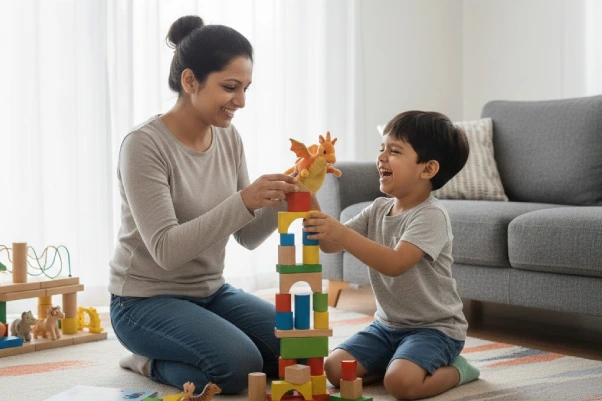
Play builds far more than fun memories. Scientific evidence shows that play strengthens:
Children who play regularly are better able to manage stress, adapt to new situations, and build strong relationships.
Over the past few decades, playtime has steadily declined. Common reasons include:
Recognizing this, pediatricians worldwide now emphasize a “prescription for play”, especially in the first two years of life, encouraging parents to protect play as a daily priority.
Playful learning starts much earlier than most parents realize.
Birth to 6 months
Play begins with eye contact, smiles, and simple interactions. When parents respond to a baby’s smile or coo, they are teaching early social and emotional skills. Imitating babbles, offering safe objects to explore, and supervised tummy time help build sensory awareness and motor strength.
7 to 12 months
At this stage, babies learn cause and effect—dropping a toy, crawling to explore, looking at themselves in mirrors, and playing peek-a-boo. These activities build object permanence, curiosity, and early problem-solving skills.
1 to 3 years is a powerful phase for play-based learning. Toddlers learn best when they lead the play.
Helpful play experiences include:
At this age, parental presence matters more than expensive toys.
4 to 6 years is the age of imagination, storytelling, and social exploration.
Children benefit from:
A little boredom is healthy—it pushes children to invent, imagine, and create.
Children need variety in play for balanced development.
Object play builds curiosity and early science skills.
Physical play strengthens motor skills, confidence, and emotional regulation.
Outdoor play improves attention span, balance, and spatial awareness.
Pretend play develops language, empathy, negotiation, and creativity.
Each type supports a different part of the developing brain.
Play is one of the strongest protectors against toxic stress. Warm, joyful interactions during play help regulate the body’s stress response.
Studies show that children entering new environments—like preschool—feel significantly calmer after even 15 minutes of free play. This makes play especially important during transitions, illness, or emotional challenges.
Some children struggle to develop play skills due to:
Warning signs include lack of pretend play, difficulty engaging with peers, or repetitive, rigid play patterns. Early developmental assessment helps identify these challenges and guide structured intervention.
Q. Is play really more important than academics early on?
Answer: Yes. Strong play skills support later academic success.
Q. How much playtime does my child need daily?
Answer: At least 1–2 hours of active, unstructured play.
Q. Are electronic toys helpful?
Answer: Simple toys and human interaction are far more effective.
Q. What if my child prefers to play alone?
Answer: Solitary play is normal, but social play should be gently encouraged.
Q. When should I seek professional advice?
Answer: If play skills are absent, rigid, or delayed for age.
“Play-based guidance helped our child engage more confidently with toys and people.”
“We finally understood how to support play at home without pressure or screens.”
“Simple changes in daily play made a noticeable difference in our child’s interaction.”
With over a decade of clinical experience, Dr. Rajeshwari Ganesh is a trusted Developmental and Behavioral Pediatrician in Mumbai, known for her calm, child-centric, and parent-empowering approach.
She has completed advanced fellowship training in Developmental & Behavioral Pediatrics from the National University Hospital, Singapore, and holds internationally recognized qualifications including MRCPCH, MD Pediatrics, DCH, and MBBS from Mumbai University.
Her work includes comprehensive developmental assessments using globally accepted tools such as Capute Scales, Amiel-Tison Scales, PEP, Early Start Denver Model Curriculum, CARS, and advanced neurodevelopmental assessments like PEER, PEERAMID, and PEEX2.
Dr. Rajeshwari Ganesh is among the few professionals in India certified to administer ADOS (Autism Diagnostic Observation Schedule) and the Bayley Scales of Infant and Toddler Development, both considered gold standards worldwide.
Play is not a luxury—it is a biological need. Through play, children build the skills they need to think, connect, cope, and thrive. By protecting time for play and responding early when challenges arise, we give children the strongest foundation for lifelong learning and emotional well-being.
Pinnacle Child Development Clinic, 202, 2nd Floor, Kanaiya Building, Opp. Airtel Store, Linking Road, Bandra West, Mumbai – 400050
📞 +91 77000 58024
📧 ganesh.ramaa@gmail.com
🌐 https://www.drrajeshwariganesh.com
🕒 Open: 24×7 × 365 Days
Copyright © 2023 | Dr. Rajeshwari Ganesh.