

Pinnacle Child Development Clinic, 202, 2nd Floor, Kanaiya Building, Opp. Airtel Store, Linking Road, Bandra West, Mumbai - 400050


"Sit down." "Wait your turn." "Please stop interrupting." Does this sound like your day?
"Sit properly."
"Don't climb there."
"Wait."
"Listen first."
"Please stop interrupting."
"How many times do I have to tell you?"
If these lines are repeated in your home every single day, you are not alone. Many parents of young children feel like they spend half the day correcting, reminding, and apologizing for behavior that seems impossible to control.
Maybe your child cannot sit through dinner. Maybe they leave their seat in the middle of a movie every few minutes. Maybe they interrupt every adult conversation, blurt things out before anyone else finishes speaking, and touch everything in a clinic or waiting room. At first, it may look like excitement, curiosity, or "just being a kid." But after a while, the pattern starts to feel too constant to ignore.
That is usually when parents stop asking, "Is this normal?" and start asking a more important question: "Could this be ADHD?"
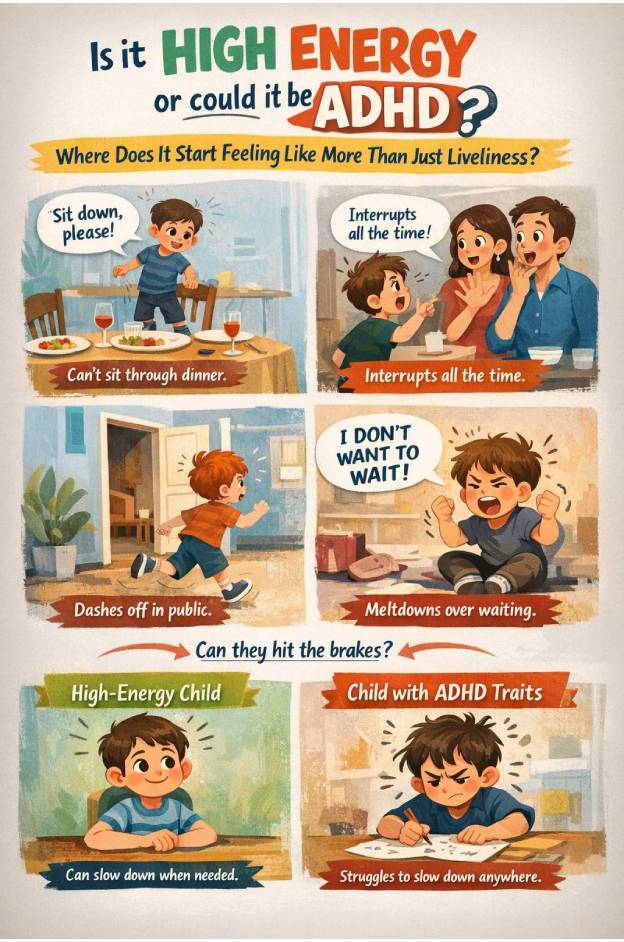
Children are naturally active. They are curious, impulsive, emotional, and easily distracted. That is part of childhood. But ADHD is not simply about being energetic or talkative.
The real concern begins when a child's activity level, impulsivity, and short attention span start affecting everyday life in a noticeable way. Meals become battles. School routines become difficult. Social situations become stressful. Parents begin to dread outings because they already know how hard it will be.
This is why families often start searching for the everyday signs of ADHD in young children. They are not looking for labels. They are looking for understanding.
From the outside, people may say:
But what looks like poor behavior is not always defiance. Sometimes it is a genuine difficulty with impulse control, emotional regulation, attention, and self-management.
A child with ADHD-like traits may not be choosing chaos. They may be struggling to slow down, hold onto instructions, wait, shift attention, or stop their body before acting.
That difference matters. A lot.
Some children are full of energy but can still settle when the situation calls for it. They may be loud and playful, but they can usually sit through a short story, slow down at school, or focus on something they enjoy.
Other children seem unable to apply the brakes, even when they want to. That is where parents start noticing the difference.
A high-energy child may need reminders.
A child with ADHD traits often needs far more than reminders.
The problem is not just movement. It is regulation.
| High-Energy Child | Child with ADHD Traits |
|---|---|
| Active, playful, lively | Restless in a way that disrupts daily life |
| Can calm down in the right setting | Struggles to slow down even when expected |
| Interrupts occasionally | Interrupts constantly |
| Usually completes enjoyable tasks | Leaves many tasks unfinished |
| Routines work with support | Routines break down every day |
| School concerns are occasional | Teacher concerns are repeated and persistent |
This is not a diagnosis tool. It is simply a way to understand why "more energy" and ADHD are not the same thing.
Parents usually do not seek help because of one dramatic incident. It is the build-up of many everyday moments:
This is often what pushes families toward an ADHD Assessment for Kids in Mumbai. Not panic. Not overreacting. Just the need for clarity.
A few signs are especially worth paying attention to when they happen often and across settings.
They cannot stay seated even briefly
Your child gets up during meals, class activities, prayer time, stories, or any situation where sitting for a short period is expected.
They interrupt almost every conversation
They talk over adults, answer before questions are finished, jump into games, and struggle to wait for their turn.
They move from one thing to another without finishing
Homework, play activities, dressing, brushing teeth, or small tasks are started but rarely completed without constant supervision.
Every routine feels harder than it should
Morning readiness, bedtime, leaving the house, and getting through simple daily transitions become repeated battles.
School is noticing it too
Teacher feedback is consistent, not occasional. That matters because ADHD patterns usually show up in more than one setting.
Impulsivity is creating problems
Running off, climbing unsafely, grabbing things, pushing into others' space, or acting before thinking can affect safety and relationships.
Not every restless child has ADHD. And not every child with ADHD looks the same.
This is exactly why proper assessment matters. A careful evaluation does not just ask, "Does your child fidget?" It looks at the whole developmental picture.
A good assessment is not a rushed opinion or a label given after one complaint. It is a structured look at the child's functioning across daily life.
It may include:
Parents looking for expert developmental guidance can consult Dr. Rajeshwari for a thoughtful and child-focused evaluation.
This is one of the first fears many parents have. The moment ADHD is mentioned, they worry the conversation will immediately end with medicine.
That is not how careful, evidence-based care works.
For many children, especially younger ones, support begins with:
Medication may be part of care for some children, but it is never the entire story.
The fidgeting is what everyone notices. But underneath that, many children are struggling with something deeper: executive function.
That includes:
So the real goal is not just "make the child sit still." The goal is to help the child function better in real life.
When a child struggles with attention and impulse control, parents often end up carrying the emotional weight of it all.
The truth is, many families feel calmer not because the child changes overnight, but because they finally get the right framework to understand what is happening.
That is where support makes a difference.
It may be time to consider an ADHD Assessment for Kids in Mumbai if:
The biggest relief for many parents is not the diagnosis itself. It is the clarity.
Once you understand whether your child is simply lively, temperamentally intense, or dealing with ADHD-related regulation challenges, you can stop guessing. And when guessing stops, support becomes far more effective.
Families concerned about the everyday signs of ADHD in young children can seek professional guidance from Dr. Rajeshwari for assessment, parent guidance, and practical next steps.
You do not have to figure it out alone. A structured evaluation can help you understand what your child's behavior is really telling you.
Book an appointment with Dr. Rajeshwari for a detailed developmental assessment and a support plan tailored to your child.
Pinnacle Child Development Clinic, 202, 2nd Floor, Kanaiya Building, Opp. Airtel Store, Linking Road, Bandra West, Mumbai – 400050
📞 +91 77000 58024
📧 ganesh.ramaa@gmail.com
🌐 https://www.drrajeshwariganesh.com
🕒 Appointments available all days